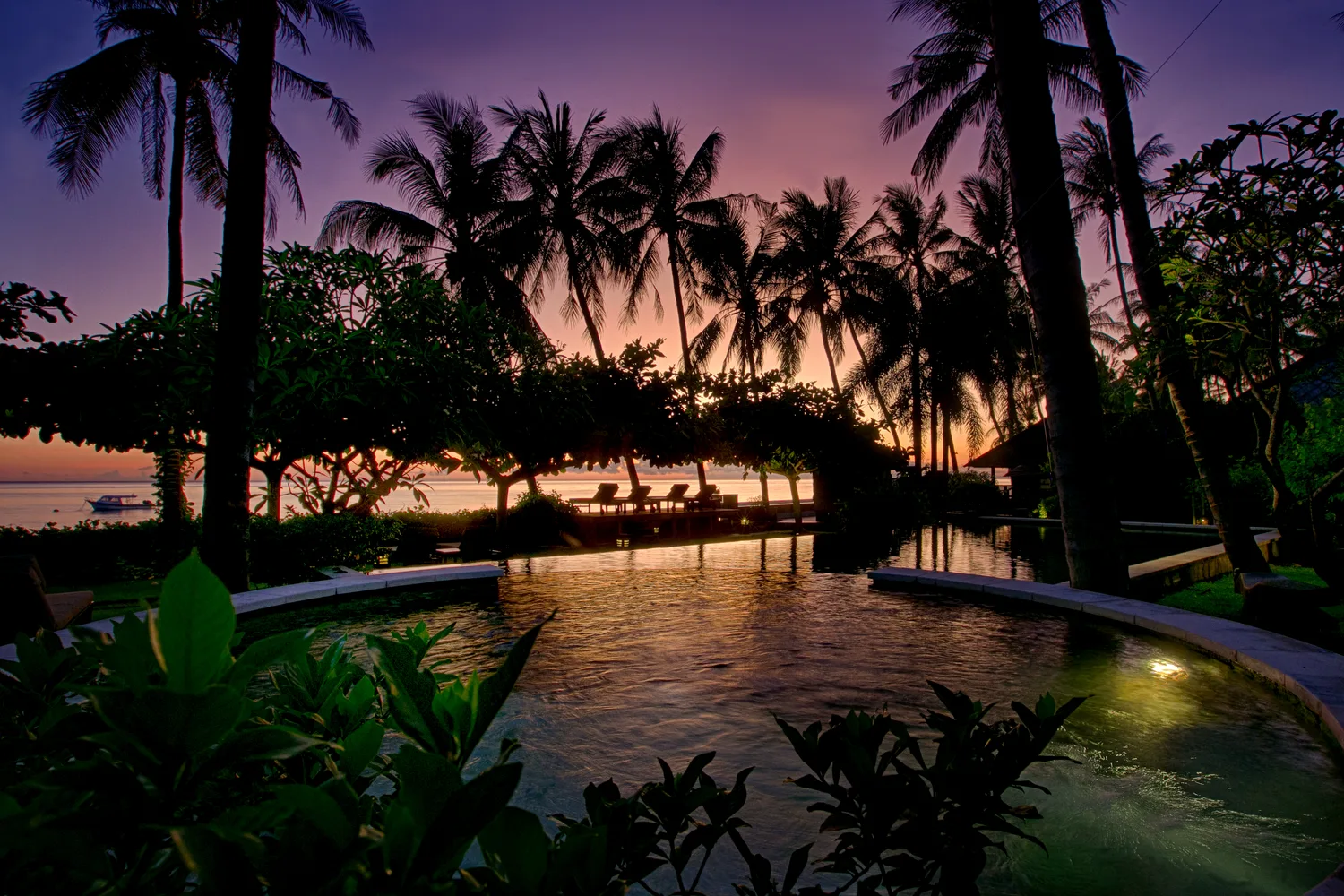
Sanur does not try to be Seminyak, and its villa market is stronger for it. The east coast’s protected reef beach, walkable promenade, established expat community, and absence of heavy nightlife tourism create the conditions for a guest segment that most Bali villa areas struggle to attract consistently: long-stay visitors who book for weeks rather than weekends, treat the property as a temporary home, and generate significantly more revenue per booking cycle than short-stay guests.
Marketing to this segment requires photography that communicates something fundamentally different from what works in Canggu or Kuta. Livability, not just visual spectacle. Calm, not energy. Space you would actually want to inhabit for two or three weeks, not a backdrop you would photograph on day one and ignore thereafter.
Understanding the Sanur Guest Profile
The guests who consistently choose Sanur over other Bali areas share a set of priorities that directly shape what your photography needs to show.
Retirees and long-stay leisure travelers value quiet, security, and walkable access to good restaurants and the beach. They are not interested in proximity to a beach club — they want a neighborhood they can settle into. Families with young children appreciate the calm, reef-protected water and the general absence of the chaotic traffic that characterizes parts of Canggu and Seminyak. Wellness-oriented guests and digital nomads on longer stays choose Sanur for the morning walk culture, the relatively uncrowded beach, and the slower pace.
Perhaps most distinctively, Sanur has a genuine expat community — people who either live there part-year or are evaluating it for longer-term residence. A well-presented Sanur villa can attract this segment, which often books outside peak seasons and at monthly rates that generate substantial total revenue even at a lower nightly number.
All of these guests share a common need: before booking for two weeks, they need to be confident they can actually live in the space comfortably. Your photography must answer that question.
What “Livability” Looks Like in Photographs
Most villa photography prioritizes drama — the pool at sunset, the master bedroom with cinematic lighting, the sweeping garden drone shot. This is appropriate for short-stay leisure bookings. For the long-stay Sanur market, the photography needs to work at a different register.
The kitchen is a primary asset. Guests staying two weeks will cook. A functional, well-equipped kitchen photographed clearly — showing counter space, appliance quality, storage, and natural light — is a conversion driver for this market in a way it simply is not for guests staying three nights. The photograph should show a kitchen that someone would actually want to spend time in, not just a styled wide-angle shot that minimizes visual complexity.
The workspace matters. A large and growing segment of Sanur’s long-stay visitors are remote workers or partially remote. A dedicated desk area, a second seating area that works for laptop use, or even a well-positioned corner with good natural light should be photographed deliberately rather than cropped out of frame. This is a differentiator that costs nothing to include and speaks directly to a booking decision.
The garden should communicate morning. Not sunset drama — morning. A Sanur garden photographed in the soft, golden light of early morning, with dew on the grass and the garden quiet, communicates the experience of having breakfast outdoors on a Tuesday during week two of your stay. This is the feeling the long-stay guest is buying.
Privacy in the garden. Extended-stay guests spend more time in the outdoor spaces than short-stay visitors. Photography should clearly communicate the degree of privacy in the garden — whether neighboring properties are visible, how the garden is screened, what the sightlines are from outside the property. This is especially important for expat and remote-worker guests who want to use outdoor space during working hours.
Sanur’s Sunrise Advantage
Sanur’s east-facing coastline is one of its strongest natural photography assets. The sun rises over the water, and on a clear morning the bay and any gardens or pools with eastern exposure receive warm, directional golden-hour light from the earliest part of the day.
For villas with ocean views or east-facing pools, sunrise photography is a meaningful differentiator. A pool photographed at 6:30am in direct golden light, with the sky orange above the tree line and the water still, produces an image that communicates the specific pleasure of being in Sanur in the morning — something that cannot be replicated with studio lighting or post-processing. This is the shot that tells a prospective long-stay guest: your mornings here will look like this.
Even for properties without direct ocean views, the quality of east-facing morning light in Sanur is exceptional and should be timed into the shoot schedule.
The Revenue Case for Long-Stay Photography
The financial argument for photography that attracts long-stay guests is compounding and worth understanding clearly.
A guest who books for 14 nights generates more total revenue per booking event than seven guests each booking two nights — with significantly lower OTA commission per night (assuming direct or near-direct booking patterns), lower housekeeping and turnover costs, lower coordination overhead for remote owners, and a guest who has invested enough in the experience to be likely to return or refer.
Long-stay guests are also less sensitive to the week-to-week pricing fluctuations that affect short-stay demand, and they often book further in advance, giving owners more revenue visibility. Photography that converts this guest type does not just fill one booking slot — it structures a more predictable and lower-cost revenue model.
For Remote Owners: The Sanur Opportunity
Many Sanur villa owners are not based in Bali. They manage properties remotely from Australia, Europe, or elsewhere, and they deal with the operational challenges of distance — limited ability to inspect the property between guests, dependence on local management, uncertainty about how the listing performs.
Sanur’s competitive landscape offers a specific advantage for owners in this position. The area sees significantly less new villa construction than Canggu or Seminyak, which means the supply of well-presented properties in the long-stay market is limited. A Sanur villa with genuinely professional photography — particularly photography that communicates livability and morning light — occupies a differentiated position in a market that is not being flooded with new competitors every quarter.
For a remote owner, the investment in professional photography is also the most direct form of quality control available. You cannot be present for every guest stay, but you can control exactly how the property presents to every potential guest who finds it online.
Browse the portfolio to see how we photograph Bali villas across different areas and guest markets. To discuss a shoot for your Sanur property, contact us.